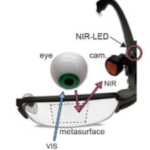
Prof. Mark Brongersma et al demonstrate a metasurface patterned on a regular pair of eyeglasses providing an unperturbed view of the world across the visible spectrum while redirecting near-infrared light to a camera, which allows imaging of the eye.
Read more about Nonlocal metasurfaces for spectrally decoupled wavefront manipulation and eye tracking
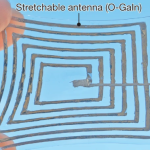
Prof. Zhenan Bao et al report intrinsically stretchable diodes capable of operating at a frequency high enough for wireless operation of soft sensors and electrochromic display pixels using RFID, in which the base-carrier frequency is 6.78 MHz or 13.56 MHz.
Read more about High-frequency and intrinsically stretchable polymer diodes
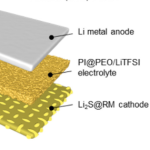
Prof. Yi Cui, Prof. Zhenan Bao et al directly track the sulfur speciation and reveal the redox chemistry for Li2S cathodes in ASSLSBs for the first time by using operando sulfur K-edge X-ray absorption spectroscopy.
Read more about All-solid-state lithium–sulfur batteries (ASSLSBs) enhanced by redox mediators (RM)
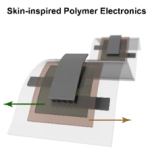
Prof. Zhenan Bao, Prof. Jian Qin et al show a molecular design concept that achieves targeted properties in both polymeric semiconductors and dielectrics and demonstrate the potential of solution-processed multilayer device manufacturing.
Read more about A molecular design approach towards elastic and multifunctional polymer electronics
