
Prof. Reinhold Dauskardt et al develop predictive models of injuries to skin due to projectiles, using simulation of projectile size, shape, orientation, friction coefficient, and impact angle.
Read more about Characterization and modeling of partial-thickness cutaneous injury from debris-simulating kinetic projectiles

Prof. Renee Zhao et al report a design strategy for snap-folding hexagonal rings that can be folded to 1.5% and 0.4% of initial area and volume, respectively, for future applications as stints, novel medical devices, and soft robotics.
Read more about Hexagonal ring origami assemblies: Foldable functional structures with extreme packing

Prof. Zhenan Bao, Prof. Parag Mallick, Prof. William Hiesinger et al develop and demonstrate a proof-of-concept wireless device that that adheres to the skin to measure changes in tumor size below.
Read more about A flexible electronic strain sensor for the real-time monitoring of tumor regression
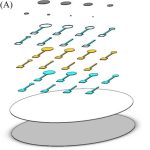
Prof. Todd Coleman et al describe a methodology that can be used to optimize the impedance characteristics of electrodes and can be applied to the design of other stretchable electronics for different target frequencies, materials and electrode sizes.
Read more about Electrochemical performance study of Ag/AgCl and Au flexible electrodes for unobtrusive monitoring of human biopotentials

Prof. Reinhold Dauskardt et al determined that for film used as an anti-fingerprint coating on touchscreen displays, humidity and other field operating conditions affect film properties making optimal cross-linking characteristics less certain, as well as the precursor chemistry to achieve them.
Read more about Insights into the mechanical properties of ultrathin perfluoropolyether−silane coatings
