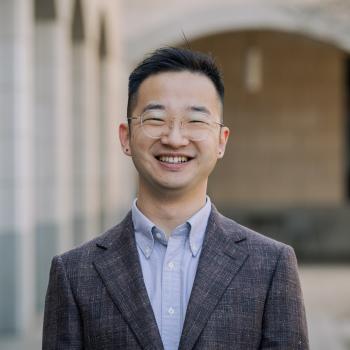
Pingyu Wang 12:30 pm to 1:00 pm “From silicon to neurons, from neurons to furrows: Sensor technologies for high-resolution, high-density data in neural and environmental systems”
Mohajeet Bhuckory 1:00 pm to 1:30 pm “Improving visual acuity outcomes with subretinal photovoltaic prostheses”
Pingyu Wang
Postdoctoral Scholar, Chemical Engineering, Stanford University
Abstract
Silicon-based microelectronic arrays (Si-MEAs) enable scalable recording and modulation of neural activity with high spatiotemporal resolution. However, their inherently planar architecture presents limitations when interfacing with three-dimensional (3D) neural structures. In this presentation, I introduce a direct-print approach for fabricating 3D microelectrodes directly on top of Si-MEAs. Using two-photon polymerization in combination with scalable microfabrication processes, this method enables customizable control over electrode position, shape, and height, allowing precise targeting of neuron populations distributed in 3D space. We demonstrate the effectiveness of this technique in retinal applications by selectively recording from retinal ganglion cell (RGC) somas while minimizing interference from passing axons. The result is high-fidelity, high-resolution, and large-scale RGC recordings with significantly reduced axonal signals—demonstrating capabilities previously unattainable with planar interfaces. This platform offers a pathway for extending Si-MEA technologies to a broad range of neural systems, with potential impacts on both fundamental neuroscience and therapeutic intervention.
In the last part of the talk, I will explore how innovations in bioelectronics and sensor design can also be leveraged to address urgent sustainability challenges. I will present my current work on developing a low-cost, low-maintenance sensor for detecting reactive nitrogen species—specifically nitrous oxide, ammonium, and nitrate—in environmental settings. These compounds play a central role in greenhouse gas emissions and water contamination yet remain difficult to monitor at scale. By enabling dense, distributed networks of sensors, this technology aims to fill critical data and knowledge gaps in environmental monitoring, advancing efforts to promote both human and planetary health.
Bio
Pingyu is a postdoctoral scholar in the Tarpeh Lab at Stanford University, where he develops low-cost, continuous sensing technologies for environmental monitoring. His current research focuses on multiplex detection of reactive nitrogen species to improve nitrogen management in agriculture and wastewater treatment.
Pingyu earned his PhD in Materials Science and Engineering at Stanford from the Melosh Lab, where he developed high-density neural interfaces for retinal prostheses aimed at vision restoration. Drawing on his background in bioelectronics and sensor design, he is interested in advancing sensing technologies to support data-driven solutions for environmental challenges.
Mohajeet Bhuckory, PhD
Instructor, Ophthalmology, Stanford University
Abstract
Subretinal photovoltaic prostheses (PRIMA) have demonstrated the ability to restore central vision in patients blinded by atrophic age-related macular degeneration (AMD). In ongoing clinical trials, these devices enable visual acuities up to 20/420 (or up to 20/70 with a digital zoom), sufficient for improved mobility and reading but still far from bridging the legal blindness limit without zoom. Achieving better visual acuity requires overcoming several fundamental challenges: miniaturizing the pixel size, improving the implant–tissue interface, minimizing inflammatory responses, and ensuring long-term stability in the subretinal environment. Here, we describe a translational pathway from today’s clinical devices to next-generation implants designed for high-acuity vision restoration, including three-dimensional electrode geometries, strategies for mitigating material-induced toxicity, and preclinical models that replicate the pathological microenvironment in AMD. By integrating engineering innovation, biocompatibility optimization, and rigorous preclinical validation, we aim to bridge the gap between current clinical outcomes and the ultimate goal of restoring near-normal visual function.
Bio
Dr. Mohajeet B Bhuckory is a biomedical researcher in the Palanker lab within the department of Ophthalmology at Stanford University, where he develops next-generation retinal prosthetic devices to restore vision in patients with macular degeneration and other retinal diseases. His research focuses on subretinal photovoltaic implants that mimic photoreceptor function and interact with retinal neurons at a cellular level. Dr. Bhuckory earned his Ph.D. from Queen’s University Belfast and has authored multiple publications on therapies to rescue photoreceptors and to restore vision after complete photoreceptor loss. Br. Bhuckory was recently awarded the BrightFocus Foundation award to start his independent research in next generation subretinal implants.
Parking Details:
Seminar Location: Y2E2 Building, Room 299 (473 Via Ortega, Stanford, CA 94305, Y2E2 Building)